

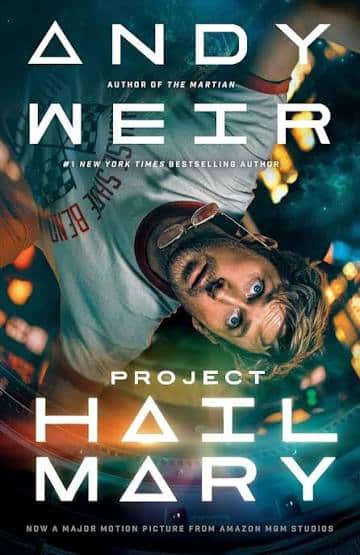
Welcome to my review of the Project Hail Mary book and movie! This one took a little more time and may be a little longer, so strap into the pilot’s chair and let’s get going. Mild spoilers ahead, though I’ll keep the big ones until the end and clearly warn for them.
Overall Movie vs Book Thoughts
The big difference is the book is hard sci-fi and the movie is not. If you watched The Martian and also read the novel, it is a similar concept.
Andy Weir wrote both novels and relied on legitimate science to go through every detail. Don’t be afraid of this though, as it is quite readable. If all else fails, you can skim the science parts. I don’t read a lot of hard sci-fi because it often lacks in the character development found in other stories, but Weir does a masterful job with it here.
The movie is definitely more character and relationship-centric, and that is a big advantage. You can enjoy the movie without ever reading the book or understanding the science as a result. And if you read the book and liked it, you can also enjoy the movie as a slightly different experience.
The Characters
Ryland Grace
Both book and movie share the same main character, Dr. Ryland Grace. In the movie, the role is played by Ryan Gosling.
Dr. Grace is a middle school teacher and disgraced molecular biologist. Unlike the main character in the Martian, he is not confident in his abilities. He doesn’t know why anyone would ask him to help solve this problem, much less go on the space mission. He is utterly charming in both book and movie.
Rocky
If you’ve seen the trailers, you know about Rocky. Rocky is perfect in every way imaginable, and is so good in the movie adaptation that you will hear people quoting him for years to come.
Rocky is an alien that Grace meets in space while trying to solve the problem and save Earth. Rocky is also there to solve the same problem, which is impacting his home world as well.
Eva Stratt
Stratt is played by Sandra Hüller in the movie and is lovely in this role as the head of the taskforce working to save Earth. The character in the movie is cold but somehow charming. She was one of my favorite parts of the movie.
I found the character in the book to be far less charming, for reasons I’ll get more into in the spoiler section.
Regardless of the medium, this character has to make some very hard decisions and clearly espouses the ends justify the means philosophy when it comes to saving humanity.
The Hook
In both the book and movie, the main problem driving the plot is something is eating energy from our sun, causing it to dim. The book and movie vary on the difference this will make to Earth’s temperature, but it is enough to be a major problem.
Britannica notes the 18-27 degree (F) drop in temperature is massive compared to the last ice age (10.8 degree drop). This would cause crop failures and famines, among other issues, leading to the death of up to half the human population in 20-30 years.
As the novel itself is hard sci fi, readers can learn far more about this process and the effect there. The movie, on the other hand, makes it clear it is a problem without digging into the science. One of Grace’s students sums it up with, “I heard that all the crops will die, the economy will free-fall, and half the Earth will die of starvation.”
Yeah, that’s bad.
The story also notes that the death count assumes that the nations of the world will somehow figure out how to get along, ration food, and share resources. I think you can see the problem here, and so do the characters. This could easily be a humanity-ending event.
The Plan
Naturally, everyone on the planet wants to fix this problem before it gets to that point. While everyone is not starving, the countries of the world do work together to study the problem.
Grace is recruited by Stratt to study samples of the material blocking our sun. He finds they are alive – an alien! Less scary looking than most aliens we see in movies, but with the potential to be much, much worse. They name it Astrophage.
They discover that most every other “nearby” star has the same problem. Astrophage is dimming all the suns, save one – Tau Ceti. Nobody knows why.
The team decides to send astronauts on a one way mission to Tau Ceti, using Astrophage to power the ship and let it obtain near light-speed. The crew will be put into a medically induced coma for the journey, and relativity means they experience less time on the journey than we will experience on Earth. They investigate, find a solution, and send back probes with the answer.
What could go wrong? Well, everything. They know it has a very low chance of success, and even if they do succeed, the solution won’t be back to Earth for over twenty years. Hence the name. A long shot = Hail Mary.
And it goes wrong before they ever take off, because the science officers Grace was training are killed in an accident. Grace is the only qualified scientist left and ends up going to save the world.
My Review (without the BIG spoilers)
If you’re into hard sci-fi, the book is fantastic. As I stated above, it gets the science right while at the same time hitting all the good story notes. This is top-tier sci fi.
No matter who you are, the movie is excellent. I laughed out loud at multiple points. I also cried at several points. The movie hits all the notes. The acting is phenomenal, and I shed more tears over a puppet rock character than I am willing to admit.
If you have children, this movie seems fairly family-friendly to me at a certain age. There is brief mention of people “hooking up” before the mission, and of course there are themes of death and a few actual deaths. The language was mild.
The book has more language and references sex more directly, but if someone is old enough to understand the science in this hard sci-fi, they probably do know what sex is.
I 100% recommend the movie to anyone I know. I think you’d enjoy it. It is available on Amazon Prime, among others.
My Spoilery Thoughts
Consider this image your last warning.

Ends and Means
It is hard to talk about the themes of this movie without noting the big spoiler. Grace did not choose to go on this mission. When presented with the choice of going willingly or staying on Earth and waiting with everyone else to die, he chose to wait on Earth.
Book Stratt has none of the compassion of Movie Stratt and calls him out as a coward. She has him sedated and sends him on his way in either story, but the book allows him to suffer in a cell for a few days before he goes and also explicitly states she adds drugs to his cocktail to make him forget he didn’t choose to go.
I found Movie Stratt to be better, in this way. Harder to accept her as a villain when we have spent the movie seeing her as a bit odd, but ultimately good person. The choice for her seems more monumental in the movie than in the book, though clearly the larger impact is on Grace.
Do the ends justify the means? This impacts more in the book than the story. Can we send Grace against his will? Should the astronauts commit suicide at the end of the mission? Should we cause ecological disaster to keep the Earth warm? Does any situation justify tyranny?
A topic that is much larger than just this story. The question impacts a lot of moral questions:
- Can we target a civilian population in war to end that war more quickly and potentially save more lives?
- Can we pre-emptively take a life if that life would not be worth living or difficult to sustain?
- Can we torture prisoners to gain information that may save lives?
Grace did not choose to be a hero; he was sacrificed for the sake of humanity because he was a qualified scientist. We would normally call this an ethical and moral problem, but do we feel that way in this story, given the stakes?
“Find someone to be brave for…”
Grace doesn’t have anyone on Earth to be brave for, ultimately leading to his decision not to leave on a suicide mission. He has no one here, “not even a dog,” but he loves himself too much to go. He is forcibly overruled and sent anyway, but he was not a brave man.
Then he finds Rocky. And faced with the choice of returning home as humanity’s savior or saving Rocky, he picks Rocky. He saves both Earth and Rocky’s planet at the same time, becoming the savior of two planets. He doesn’t seem to care.
The love of friendship makes Grace brave, and I love this about him. It is so easy to think we would be brave in a scary situation, but would we? Would we get on that ship to save the planet? Or would we need to find someone to be brave for?
Suffering
Everybody suffers. We all hate it. In this case, Grace suffers because the world is ending. He suffers when he’s thrown onto a ship against his will. He suffers the distress of spending most of the story thinking he will die at the end. And he suffers when he choses not to go home.
Hopefully none of those things befall us in this life, but I actually like his response to most of it. Even choosing to not go on a suicide mission is not really a bad response; we prefer the brave response, but it is entirely reasonable to say no in that situation.
Story problems do not get solved by people who wallow in their suffering. That would make a terrible novel or movie. Like life, problems are solved by people who see the problem and elect to do something about it. They try. They may fail, but if they didn’t try at all, they would certainly fail. That’s why we like them in stories.
Parting Thoughts
I loved this movie. I loved the book. Both made me think, in different ways. I hope he writes another book, and I hope they make another movie. They are 2/2 between this and The Martian, and I can’t wait for more.
What did you think of the book and/or movie?

Leave a Reply